Công ty cổ phần công nghệ và tư vấn CIC

Construction Robots and Their Practical Value for Modern Construction Sites
KOMPAS-3D V24 Launches with Major Upgrades for Mechanical Design
5 Principles for Effective BIM Implementation in Vietnam
OpenFlows Water & Sewer 2026 – Bentley’s Powerful Software Duo

enjiCAD 2027 Officially Launched with Breakthrough Performance and an Enhanced Design Experience...
Nội dung chính
Applications of Artificial Intelligence (AI) in Geoscience
23/07/2026
Lượt xem 9
AI is expected to transform the geoscience sector, but the greatest challenges lie not in the capabilities of AI models, but in data, context and reliability. According to Seequent, AI can only create genuine value when it is built on a foundation of high-quality data and integrated into the workflows of geoscience professionals.
Everything Starts with Data
The foundation of Seequent’s AI strategy is based on a simple principle: AI is only effective when it is provided with complete, accurate and contextualised data.
Geoscience data is inherently complex, fragmented and often distributed across multiple systems. Without sufficient context, provenance and data structure, even the most advanced AI models may struggle to produce reliable results. This is particularly important for critical tasks such as ore-grade classification and resource estimation, where the quality of decisions always depends on the quality of the input data.
This is why Seequent developed Seequent Evo – a unified data platform that connects geoscience data, computing capabilities and workflows within a single environment. As a result, AI can operate on trusted data sources, reduce uncertainty and support professionals in making more accurate decisions.
When data is standardised and connected, AI is no longer simply a tool for answering questions. It can become an intelligent assistant that directly supports specialised geoscience workflows.
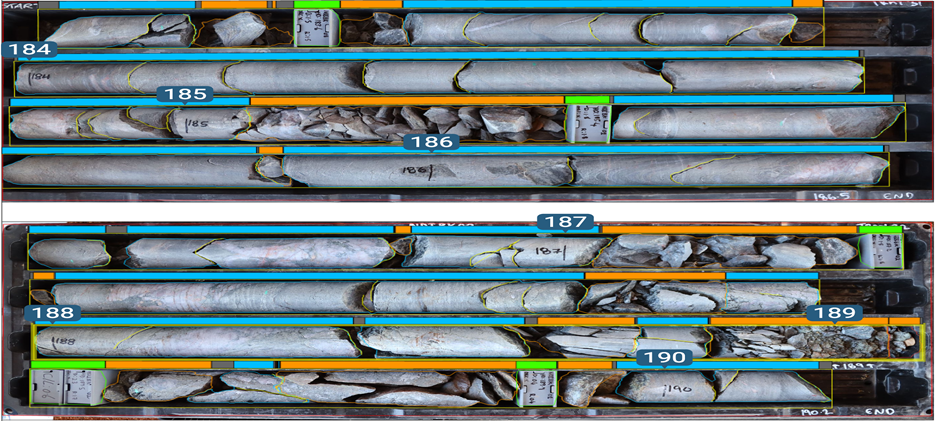
AI-powered core image analysis in Seequent Imago can automatically detect and classify core intervals, transforming images captured during everyday operations into structured data ready for analysis and modelling.
What Is Vibe Coding and Why Does It Matter to Geoscientists?
Vibe Coding is a new software development approach in which users describe their requirements in natural language, while AI automatically generates the source code and builds the application instead of requiring users to program every line of code. This enables scientists and geoscience professionals to develop solutions tailored to their specific data and technical challenges without needing programming skills.
Read more: AI in the Construction Industry: From a Supporting Tool to a Core Competitive Capability
To support this trend, Seequent provides the Evo Python SDK, a toolkit designed to simplify the use of Seequent Evo APIs. This allows users to develop applications on the Seequent Evo platform more easily using popular AI development environments such as Claude Code or Visual Studio Code (VS Code).
Vibe Coding significantly shortens the time required to move an idea to a prototype. It also enables users to quickly develop solutions that address specific requirements by leveraging Seequent Evo’s data platform and computing capabilities. However, AI-assisted application development also presents several challenges, including unverified source code, the accumulation of technical debt and potential difficulties with long-term maintenance.
Organisations therefore need to balance speed and flexibility with requirements related to governance, reliability and operational readiness in enterprise environments.
What Role Does MCP Play?
Last year, Seequent released the Evo Model Context Protocol (MCP) Server on GitHub. MCP is an emerging standard designed to help AI agents connect with external systems, data sources and specialised tools. It provides a standardised method through which AI can query data, interact with applications and operate safely within established access permissions and rules.
In simple terms, MCP acts as a bridge between AI systems such as Claude and real-world systems such as Seequent software. With MCP, AI is no longer limited to providing text-based answers. It can directly access enterprise data and perform tasks within connected systems. While APIs are designed to help developers connect different software applications, MCP is designed to allow AI models to connect to and work with those systems.
AI Supports Complex Geoscience Tasks
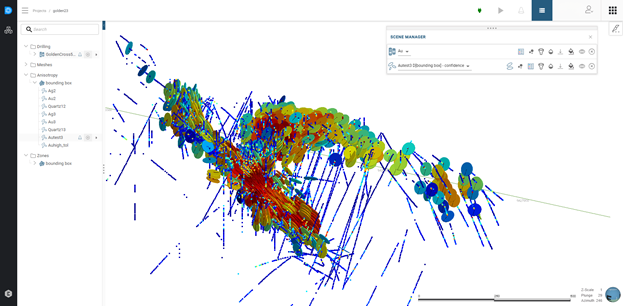
Seequent demonstrated an AI agent using the Evo MCP Server to automatically perform an entire Kriging workflow based solely on a natural-language request. The AI was able to select data, prepare the model and run the calculations without requiring the user to write code, demonstrating the potential of AI to automate geoscience tasks.
MCP and Vibe Coding – Technologies That Enable AI
According to Seequent, MCP and Vibe Coding are technologies that help AI connect with geoscience data and workflows while enabling users to develop their own AI applications. However, these technologies are only foundational tools rather than the ultimate objective.
The Future of AI in Geoscience
Seequent is focusing on developing AI solutions that are integrated directly into products such as Driver, Imago and Evo, allowing geoscientists to benefit AI without needing programming skills. Seequent’s direction is to develop AI based on trusted data, real-world workflows and solutions specifically designed for the geoscience sector, helping users make faster and more accurate decisions.
As AI, data and digital platforms play an increasingly important role in geoscience, mining, infrastructure and environmental fields, organisations need to select appropriate technology solutions to strengthen their analysis, modelling and decision-making capabilities.
CIC works alongside organisations, businesses and specialised units by providing access to, consulting on and implementing engineering software, digital technology and digital transformation solutions for the construction, geoscience, infrastructure and natural resources sectors.
CIC CONSTRUCTION TECHNOLOGY AND CONSULTANCY JOINT STOCK COMPANY
Head Office: 4th Floor, VG Building, No. 235 Nguyen Trai Street, Khuong Dinh Ward, Hanoi, Vietnam
Ho Chi Minh City Branch: No. 36 Nguyen Huy Luong Street, Binh Thanh Ward, Ho Chi Minh City
Telephone:
-
Hanoi: 024 3976 1381
-
Ho Chi Minh City: 088 645 2020 – 028 628 99022 – 028 628 99033
Email: info@cic.com.vn | cichcm@cic.com.vn
Website: cic.com.vn