Công ty cổ phần công nghệ và tư vấn CIC
Specialized
Home > News > Specialized > Construction Site Digital Revolution: Solving the Construction Labor Crisis with Intelligent Robots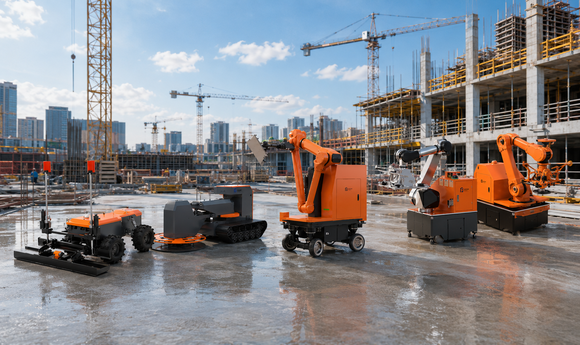
Construction Robots and Their Practical Value for Modern Construction Sites

KOMPAS-3D V24 Launches with Major Upgrades for Mechanical Design
5 Principles for Effective BIM Implementation in Vietnam
OpenFlows Water & Sewer 2026 – Bentley’s Powerful Software Duo

enjiCAD 2027 Officially Launched with Breakthrough Performance and an Enhanced Design Experience...
Nội dung chính
Construction Site Digital Revolution: Solving the Construction Labor Crisis with Intelligent Robots
12/06/2026
Lượt xem 16
In the face of this labor crisis, “robots replacing humans” is no longer a futuristic option, but an inevitable trend with a direct impact on business survival. The rise of technology companies, together with Embodied AI solutions, is redefining the way we build the world.
1. Construction Labor Crisis: A Global Wake-up Call
According to real-world data, the number of frontline workers in the construction industry is declining sharply. In many markets, workers over the age of 45 already ac for more than 60% of the workforce, while the number of young workers under 30 remains critically limited.
In addition, traditional construction work is often associated with high risks, dusty environments, and heavy physical demands. As experienced skilled workers retire without a sufficient next generation to replace them, contractors are forced to seek a consistent, continuously operating solution that is less dependent on human labor. This is where construction robots step onto the stage.
2. Embodied AI and Architectural Large Models: A Breakthrough Brain for Construction
What sets today’s generation of construction robots apart previous mechanical machines is the combination of Embodied AI and specialized Architectural Large Models.
Instead of simply repeating fixed movements, intelligent construction robots are equipped with 3D scanning systems and smart planning capabilities using multi-beam LiDAR and computer vision technologies, enabling them to:
-
Perceive real-world conditions: Robots can scan construction spaces, identify structural components, and detect obstacles automatically.
-
Plan intelligently: They can automatically calculate the most optimal movement paths and construction methods.
-
Execute with precision: Robotic arms equipped with force sensors can perform tasks with millimeter-level accuracy.
This advancement allows robots to adapt effectively to dynamic, dusty, uneven, and constantly changing construction site environments — something traditional factory robots were never designed to handle.
3. A Practical Construction Robot Ecosystem: From Structural Work to Finishing
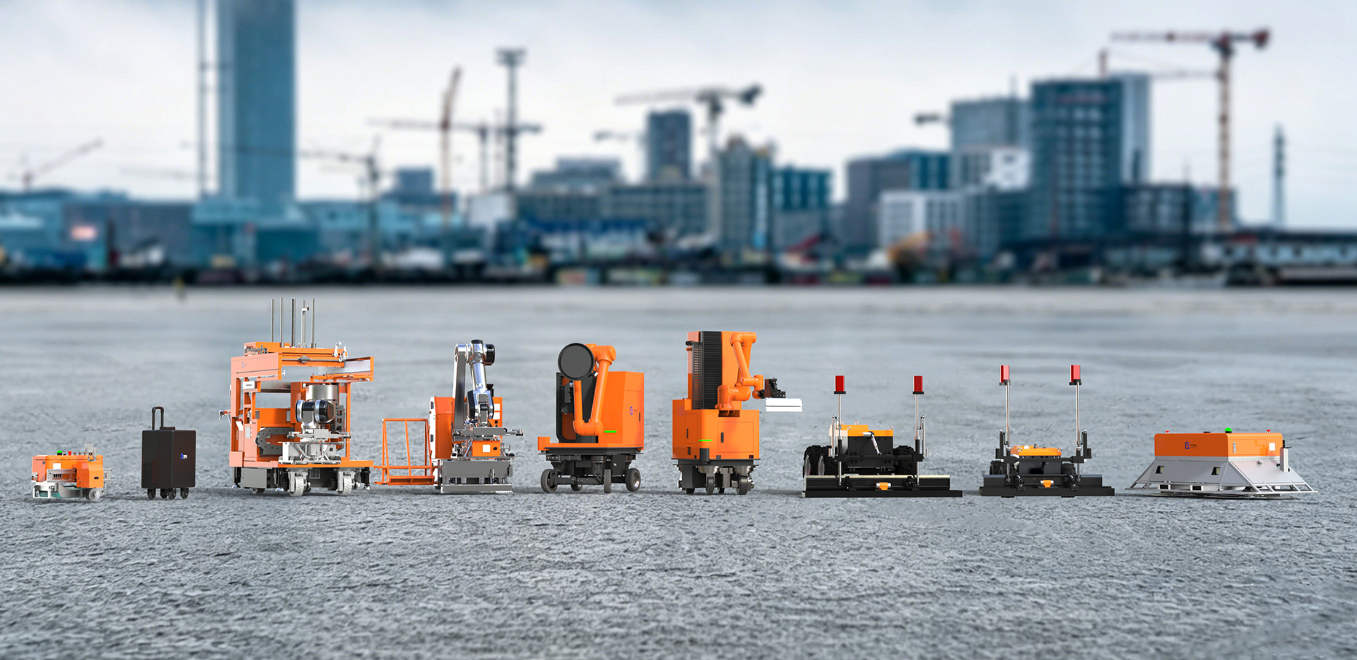
Modern robotic systems now cover the full lifecycle of a construction project, divided into key product lines that directly address the most labor-intensive stages.
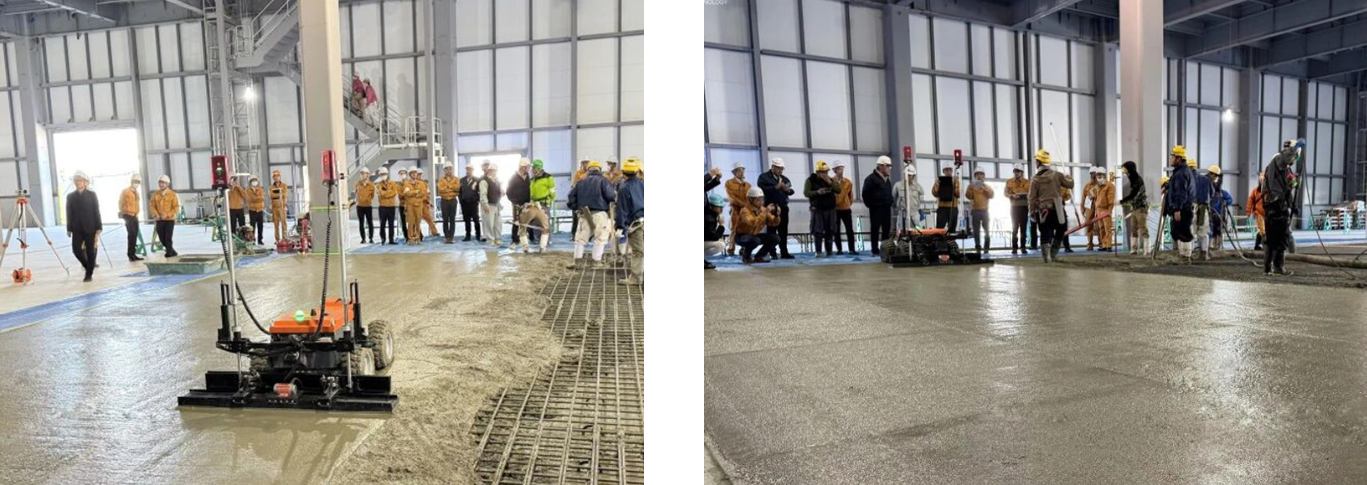
Concrete Floor Construction
Representative product: Concrete screeding robot
-
Strengths: The robot can achieve an accuracy tolerance of only ±2mm and a working productivity of 400–600 m² per hour. A single unit can replace 3 to 5 skilled workers, reduce labor costs by more than 60%, and operate on battery power with no harmful emissions.
-
Supporting equipment: It can be used together with dual-disc floor grinding and polishing robots to deliver a high-quality finished surface.
Wall Putty, Sanding, and Surface Painting
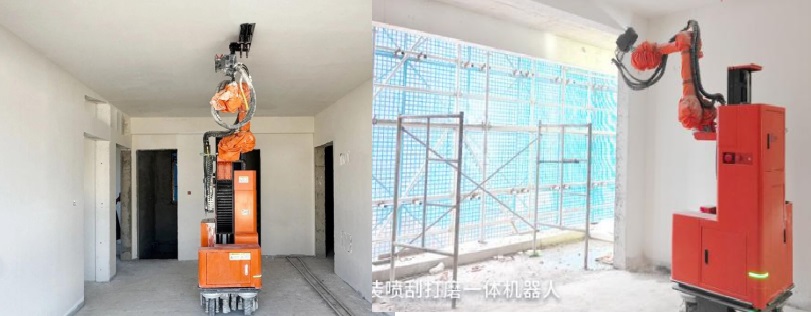
Representative product: Integrated robot for putty spraying, sanding, and wall painting
-
Strengths: The robot uses a flexible six-axis robotic arm mounted on an omnidirectional mobile platform. It can automatically process walls and ceilings 3.3m to 4.5m high, working 3 to 5 times faster than manual painters. This helps reduce up to 90% of labor costs for plastering and coating work while protecting workers’ lungs harmful paint dust.
Tile and Large-Format Stone Installation
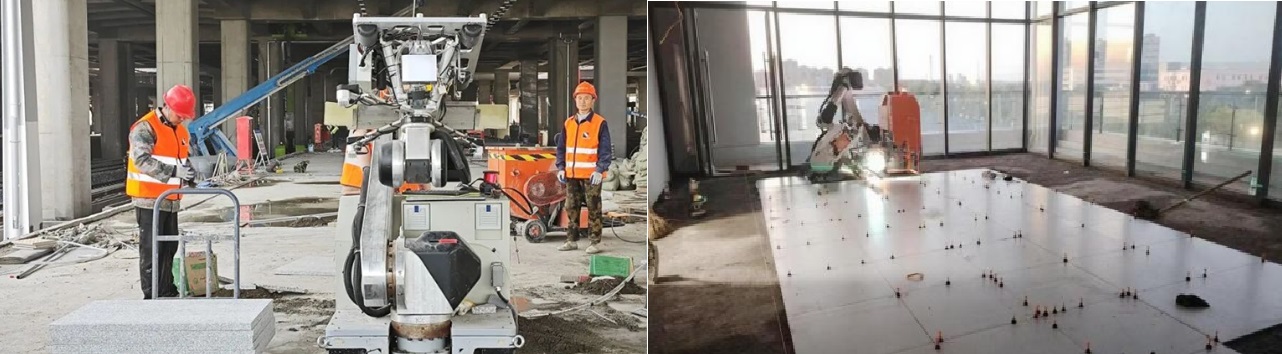
Installing large granite slabs weighing dozens of kilograms requires highly skilled workers and carries a high risk of back injuries. Tiling robots use end-effector force control mechanisms to precisely align tile joints and elevations down to the millimeter, delivering a consistently refined and uniform finish.
4. Proven Performance on Global Mega Projects
Construction robot technology is no longer limited to demonstration videos in laboratories. It has already been deployed across hundreds of major projects worldwide.
-
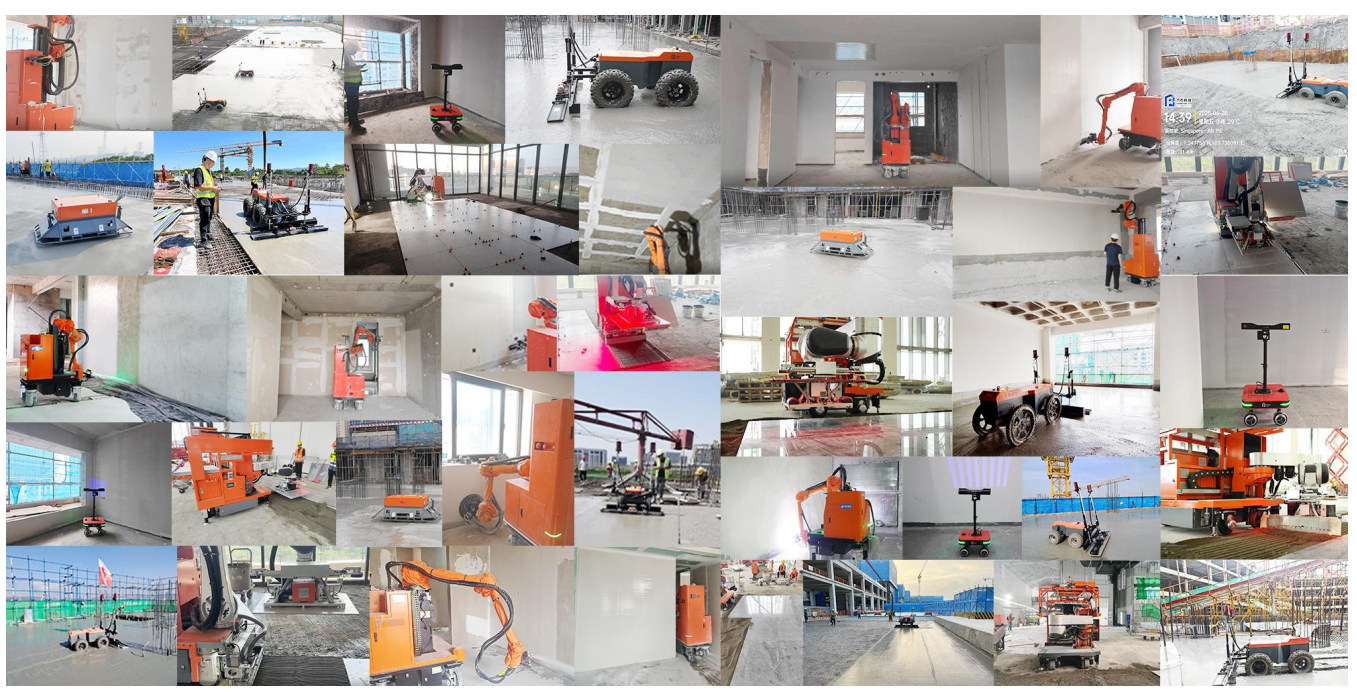
In China: These robots have served more than 100 major general contractors, including CSCEC and CRCC, and have participated in more than 500 landmark projects, such as Guangzhou Baiyun International Airport, Shenzhen International Trade Center, and Shanghai Songjiang Railway Station. Their cumulative construction area has exceeded 15 million square meters.
-
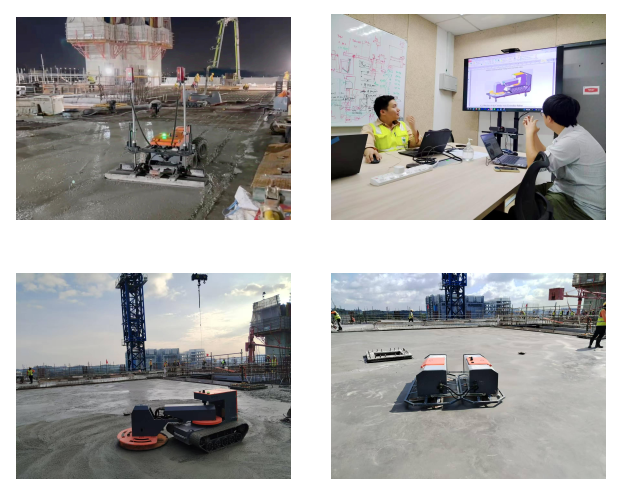
In Singapore: During the concrete pouring phase for infrastructure works at the DG Tuas Project, multiple robots were deployed to ensure both progress and quality despite the severe labor shortage faced by the island nation.
-
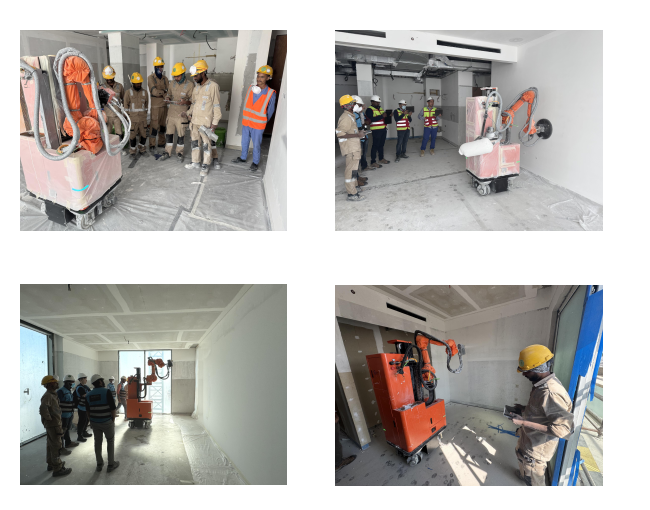
In the Middle East, UAE/Dubai: In the heart of bustling Dubai, putty spraying and wall grinding robots are supporting the construction of high-end residential developments for top real estate developers in the UAE.
The adoption of robots in civil construction is not intended to “take away” human jobs. Instead, it is a solution that frees people the heaviest, most hazardous, and most physically demanding tasks.
The combination of Embodied AI and precision robotic arms is the golden key that helps contractors overcome labor shortages, ensure project schedules, and move toward a construction industry that is more efficient, safer, and greener.
For more information, please contact:
-
Software Solutions and Technology Equipment Center - CIC Technology and Consultancy Joint Stock Company
-
Hotline: 0976 268 036 / 024 3974 1373