Công ty cổ phần công nghệ và tư vấn CIC
Construction Robots and Their Practical Value for Modern Construction Sites
KOMPAS-3D V24 Launches with Major Upgrades for Mechanical Design
5 Principles for Effective BIM Implementation in Vietnam
OpenFlows Water & Sewer 2026 – Bentley’s Powerful Software Duo

enjiCAD 2027 Officially Launched with Breakthrough Performance and an Enhanced Design Experience...
New Regulations On Bim Implementation In Vietnam
25/06/2026
Lượt xem 156
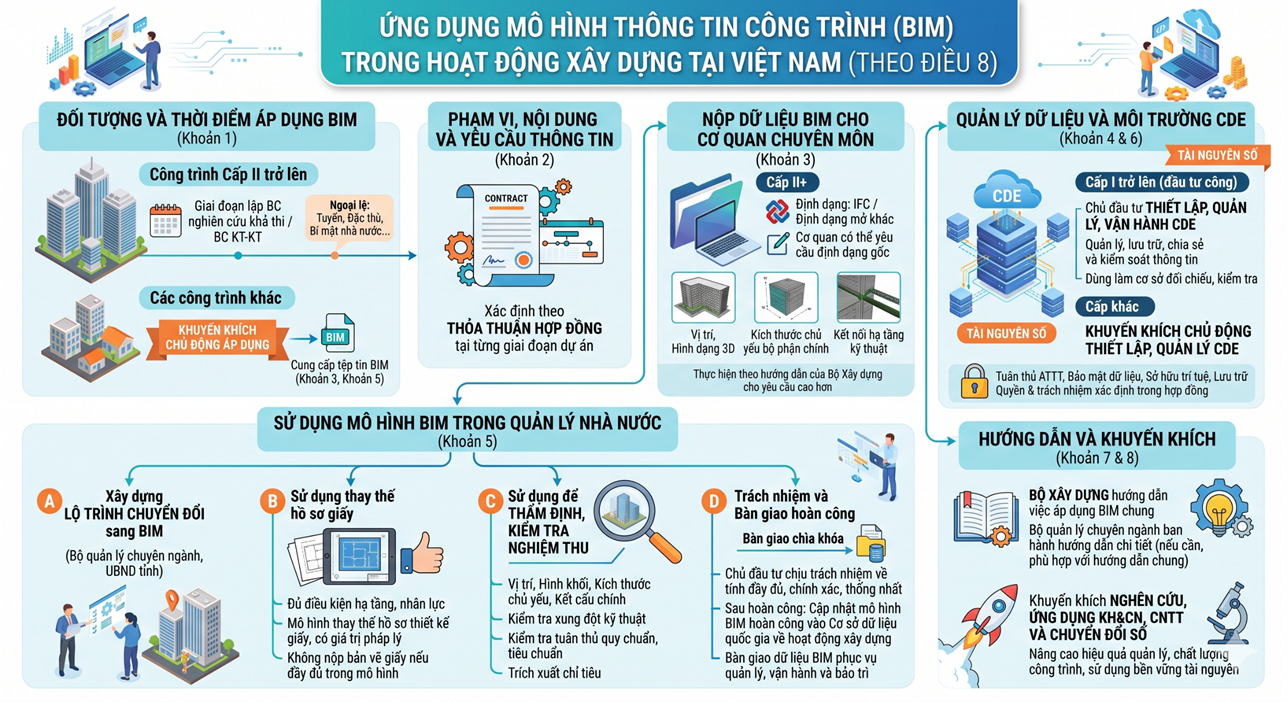
Building Information Modeling (BIM) has become a core component of the digital transformation strategy for Vietnam’s construction industry. With the issuance of Decree No. 217/2026/ND-CP, detailing a number of articles of the 2025 Law on Construction regarding the management of construction activities, effective 1 July 2026, the legal framework for BIM implementation has officially entered a new phase: more stringent, yet more flexible.
This article summarizes and provides a detailed comparison of the key changes introduced in Article 8 of Decree No. 217/2026/ND-CP against the former Decree No. 175/2024/ND-CP. The aim is to help investors, consulting firms, and contractors promptly update their workflows and optimize project management processes.
I. Key Changes in Article 8 of Decree No. 217/2026/ND-CP Compared with Decree No. 175/2024/ND-CP
|
Comparison Criteria |
Decree No. 175/2024/ND-CP |
Decree No. 217/2026/ND-CP |
|
Mandatory application conditions |
BIM application was required only when both the construction work grade condition, Grade II or higher, and the project scale condition, Group B or higher, were met simultaneously. |
BIM is applied consistently to all newly constructed works of Grade II or higher, starting the feasibility study report preparation stage. |
|
Legal value of the model |
BIM data served as a supporting tool for competent authorities during the review and appraisal of submitted dossiers. |
BIM models may be used as a complete substitute for paper-based design dossiers and have equivalent legal validity. |
|
Reduction of administrative procedures |
Investors were still required to submit traditional paper drawings in parallel with BIM model files. |
Paper drawings are exempted for all contents that have been fully and accurately represented in the BIM model. |
|
Common Data Environment (CDE) |
There was no clear legal requirement on the mandatory use of CDE for each construction work scale segment. |
Establishment and operation of a Common Data Environment are mandatory for Grade I or higher construction works under public investment projects. |
|
Handover data formats |
File format standards for dossier submission were not strictly regulated. |
Open standard formats such as IFC, or other open formats suitable for the specific characteristics of the construction work, are prioritized. |
II. Key Updates Reshaping the Digital Construction Workflow
1. The Era of Comprehensive Digitalization – Optimizing Operating Costs
The most significant breakthrough under Clause 5(b), Article 8 of Decree No. 217/2026/ND-CP is the recognition of BIM models as having legal validity equivalent to paper drawings. Once the technical infrastructure of competent authorities is sufficiently developed, appraisal and acceptance procedures can be carried out directly in a digital environment.
This change enables enterprises to significantly reduce printing and archiving costs while shortening the processing time for administrative procedures.
2. Standardizing the Common Data Environment (CDE) – A Foundation for Real-Time Collaboration
The mandatory establishment of a Common Data Environment (CDE) for large-scale public investment projects, Grade I or higher, represents a strategic move to eliminate information discrepancies among project stakeholders.
The CDE serves as the single source of truth for data comparison, technical review, and quality control. It also enhances transparency and helps manage design clash risks the early stages of project implementation.
3. As-Built BIM and Lifecycle Asset Management
The new decree expands the scope of BIM beyond the design and construction phases. Upon completion of a construction work, investors are required to update the standardized as-built BIM model into the National Database on Construction Activities.
All relevant data must also be handed over to the operation and maintenance unit for future use, supporting smarter maintenance, repair, and facility management throughout the asset lifecycle.
Compiled by: Đức Thành, with the assistance of AI
CIC Construction Technology and Consultancy Joint Stock Company (CIC)
Head Office: VG Building, 235 Nguyen Trai Street, Thanh Xuan Ward, Hanoi, Vietnam
Mr. Thành: 0966.9040.15
- Consultancy on BIM-related software: Revit, Tekla, Allplan, Autodesk Construction Cloud, Dalux, Procore, etc.
- Smart City consultancy
- Consultancy on BIM model creation, including 3D, 4D, 5D, and 6D models, in compliance with legal regulations, using modeling tools such as Revit, Tekla, and Allplan
- BIM model review and verification consultancy
- BIM training consultancy in accordance with legal regulations and ISO 19650
- Digital Twins consultancy
- Consultancy on AI strategies and AI tools